Rugby Landlords Upgrading to EPC C Despite Implementation Uncertainty
If you own rental property in Rugby or across the West Midlands, you've probably heard that the government just confirmed October 2030 as the EPC C deadline for all rental properties.⁽¹⁾ But here's the reality check: while the deadline is now set, the announcement has actually created more uncertainty for landlords, not less.
The numbers tell you why this is still complicated. According to the latest English Private Landlord Survey, 59% of landlords have at least one property below EPC C.⁽²⁾ And achieving EPC C on older properties isn't just expensive—it's genuinely difficult.
Walk down Clifton Road or through Brownsover in Rugby, and you'll see the challenge. Victorian terraces with solid walls. 1960s semis in Bilton with single glazing. Period properties in Newbold that were perfectly rentable five years ago but would need substantial intervention to reach EPC C. These aren't edge cases in Rugby—they're typical.
So why are some landlords already upgrading despite the uncertainty? Because they're treating this as a business opportunity, not a regulatory panic.

Photo by Abacus Property Group
The 2030 Deadline Is Confirmed—But Implementation Chaos Remains
Let's be honest about what the 22 January Warm Homes Plan actually confirmed—and what it left wide open.
What we now know for certain:
Single deadline: October 2030 for ALL tenancies (no phased implementation)⁽¹⁾
Cost cap: £10,000 maximum required spend (reduced from the previously proposed £15,000)⁽¹⁾
It's happening: This is now government policy, not consultation
What's still completely unclear:
New EPC metrics won't be defined until late 2026.⁽¹⁾ The government is introducing entirely new assessment criteria measuring fabric performance, heating system efficiency, and smart readiness—but they won't tell us exactly what those metrics look like until late 2026. That's a problem. Properties currently rated C might drop to D under the new system. You could spend £8,000 upgrading to C today, only to find you need further work under the new metrics.
The sheer scale makes full enforcement questionable. When 59% of landlords have properties below EPC C,⁽²⁾ enforcing this across millions of properties by 2030 would be logistically challenging. Industry experts have called the compliance deadline "unrealistic"⁽³⁾ given supply chain capacity. Local authorities lack the resources for widespread enforcement, and mass evictions of non-compliant tenants would create a political crisis no government wants.
Achieving EPC C on older properties is genuinely hard. This isn't just about slapping in some loft insulation. Rugby's older housing stock presents serious challenges. Many properties have solid walls, not cavity walls. Solid wall insulation—the biggest game-changer for EPC ratings—costs significantly more and is far more disruptive than cavity wall work.⁽⁵⁾
The £10,000 cost cap creates compliance limbo.⁽¹⁾ Many Rugby properties will hit that cap before reaching EPC C. What happens then? The government says you'll be compliant if you've spent the cap—but you won't actually have an EPC C property. That creates mortgage, insurance, and tenant communication complications that haven't been worked through.
Funding support remains vague. The £15 billion Warm Homes Plan exists, but landlord-specific support is unclear.⁽⁴⁾ Most funding appears targeted at owner-occupiers and social housing, leaving private landlords uncertain about what help—if any—they'll actually receive.
And yet—despite all this implementation uncertainty—the strategic landlords we work with across the West Midlands are already planning upgrades. Here's why.

Photo by Abacus Property Group
The Business Case for Upgrading (Regardless of Regulation)
Strip away the regulatory noise, and there's a straightforward commercial argument for improving your property's energy efficiency now:
Rental premium and tenant demand.
Energy-efficient properties command higher rents and let faster. When tenants are comparing two similar properties in Rugby, the one with lower energy bills wins—especially during winter viewings when heating costs dominate tenant decision-making. We're seeing EPC C properties let significantly faster than E-rated equivalents across the West Midlands.
Reduced void periods mean more rental income.
Faster lettings aren't just convenient—they directly protect your annual yield. A property that sits empty for an extra month while you find tenants has effectively lost 8% of its annual income.
Tenant retention and reduced turnover costs.
Better-insulated properties with lower energy bills create happier tenants who stay longer. Every avoided turnover saves you re-letting fees, void periods, and the hassle of finding new occupants.
Asset protection now that October 2030 is confirmed.
The deadline uncertainty is gone—October 2030 is happening.⁽¹⁾ Upgrading now—on your timeline and budget—beats scrambling in 2029 alongside thousands of other panicking landlords when supply chains are overwhelmed and contractors are charging premium rates.
Market differentiation while competitors wait.
Right now, you can market a property as "energy-efficient" and "future-ready" while most competitors are still hoping the problem goes away. That positioning advantage disappears the moment everyone scrambles to comply.
What Actually Gets You to EPC C in Rugby Properties
We've delivered £5.8 million in client projects across the West Midlands over six years, and we've learned what works in Rugby's housing stock—and what's expensive theatre.
The challenge for Rugby landlords is that the housing stock is genuinely difficult to upgrade:

Photo by Abacus Property Group
Solid wall insulation is the biggest hurdle. Many of Rugby's older properties have solid walls, not cavity walls. External wall insulation currently costs £90-£150 per square metre,⁽⁶⁾ meaning a typical three-bed terrace can run £10,000-£20,000+ just for wall insulation.⁽⁷⁾ Internal solid wall insulation is cheaper (£60-£100 per m²)⁽⁶⁾ but reduces room sizes and is hugely disruptive if tenants are in situ.
Heating systems matter more than most landlords realise. Replacing an old boiler with an A-rated condensing boiler can bump you up half an EPC band. For future-proofing, air source heat pumps qualify for £7,500 government grants under the Boiler Upgrade Scheme (extended until at least 2030),⁽⁸⁾ though total installation still runs several thousand pounds even after the grant.
Loft insulation delivers the biggest bang per pound. Topping up to 270mm is relatively affordable and can lift a property up one EPC band on its own.⁽⁹⁾ We've seen this work effectively in Overslade and Hillmorton properties.
Windows and glazing help, but won't solve the problem alone. Double glazing replacement is expensive and won't get you to EPC C on its own if your walls aren't insulated.
A critical warning about current upgrades: With new EPC metrics arriving in late 2026,⁽¹⁾ there's a real risk that works completed now might not count the same way under the new system. Consider focusing on measures that will clearly improve fabric performance (insulation, draught-proofing) rather than measures that might be assessed differently under new metrics.
The reality is that achieving EPC C from E or D on a typical Victorian Rugby terrace isn't a quick fix. It requires thoughtful planning, substantial investment, and realistic expectations about what's achievable within the £10,000 cost cap.⁽¹⁾
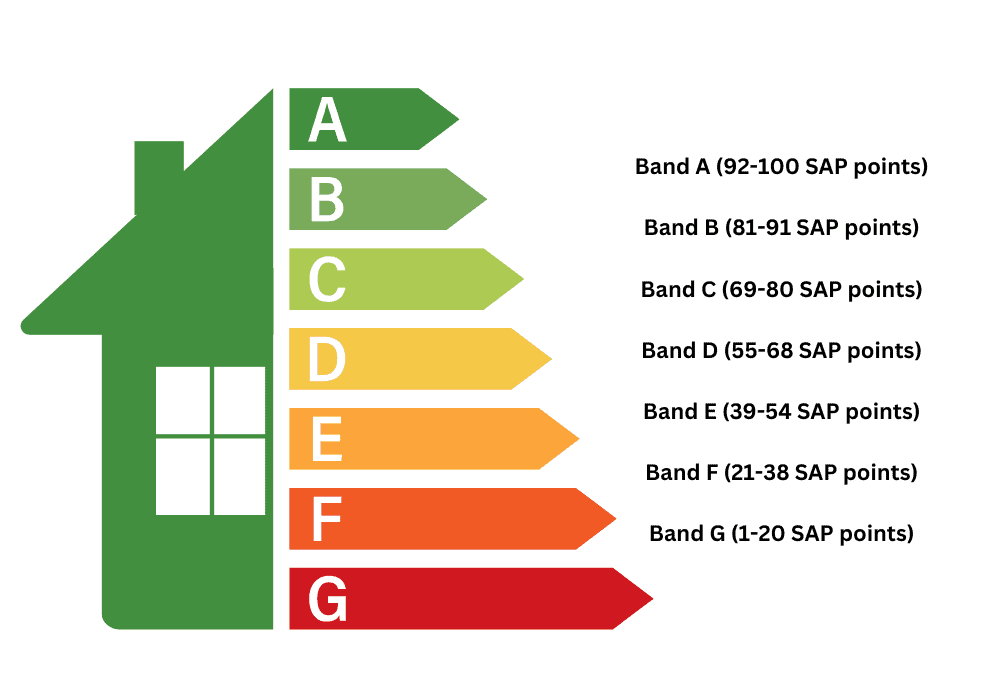
Photo by renewablesadvice.com
Why 2025-2026 Is Still Your Strategic Window
Every landlord we speak with in Rugby has the same plan: "I'll wait until we see the new EPC metrics in late 2026."
Here's why that's expensive thinking, even with metrics uncertainty:
Builder capacity is the real constraint, not regulation. Rugby Borough has thousands of rental properties. With millions of properties nationally needing upgrades by October 2030, demand will massively exceed supply. We're already seeing 12-16 week lead times for specialist insulation work in Warwickshire. Imagine what those lead times look like in 2028-2029 when everyone's scrambling to meet a now-confirmed deadline.
Material costs aren't trending downward. Construction material prices surged 34% between 2021-2023.⁽¹⁰⁾ While they've stabilised, there's no reason to expect prices to drop. With a confirmed 2030 deadline, expect further increases as suppliers respond to compressed timelines and guaranteed demand.
Grant availability is finite and competitive. Current schemes like ECO4, the Great British Insulation Scheme (running until March 2026),⁽¹¹⁾ and the Boiler Upgrade Scheme⁽⁸⁾ have limited funding. With 2030 now confirmed, applications will increase. Waiting means competing with every other landlord for diminishing grant money.
The £10,000 cost cap rewards early action.⁽¹⁾ If you can achieve EPC C for under £10,000, you're fully compliant. If you can't, you've at least hit the cap and met your legal obligation. Either way, spreading costs across 2025-2029 is financially smarter than cramming everything into 2029.
Tenant disruption is easier to manage with planning. Acting now lets you schedule works around natural tenancy transitions rather than forcing disruptive upgrades mid-tenancy or losing rental income during void periods.
The landlords succeeding in this market aren't waiting for metric certainty. They're treating energy efficiency as portfolio optimisation and acting accordingly.

Photo by Jimmy Nilsson Masth
What Rugby Landlords Should Actually Do This Quarter
Commission updated EPC assessments. If your certificates are older than two years, get new ones. EPC assessment methodologies are evolving, and your rating might differ from what you remember. Cost: £60-£90 per property. Important: keep records of current ratings—you may need to demonstrate what changed when new metrics arrive in late 2026.⁽¹⁾
Get proper retrofit assessments, not guesses. Don't assume you know what your property needs. A professional assessment identifies the most cost-effective route to EPC C for your specific property type, construction, and current condition. This is where Abacus's project management expertise makes a real difference.
Model your costs against the £10,000 cap.⁽¹⁾ Generic national averages are misleading. You need actual quotes for your specific Rugby properties, factoring in solid walls, property size, current condition, and access challenges. Critically, work out whether you can achieve EPC C within £10,000, or whether you'll need to spend the cap and document that you've met your legal obligation despite not reaching C.
Check grant eligibility thoroughly. The ECO4 scheme, Boiler Upgrade Scheme,⁽⁸⁾ Great British Insulation Scheme,⁽¹¹⁾ and Warm Homes Local Grant can significantly reduce costs—but applications take time to process, eligibility criteria are strict, and funding isn't unlimited. With 2030 confirmed, expect increased competition for these funds.
Factor EPC into your acquisition strategy. If you're buying property in Rugby this year, either negotiate hard on properties needing EPC work or specifically target properties already at C or above. The discount you can achieve on sub-EPC C properties is growing as the October 2030 deadline firms up market expectations.⁽¹⁾
Plan around tenancy cycles and the October 2030 deadline. If you have tenancies ending in 2025-2028, those are your natural windows for upgrade works with minimal income loss and tenant disruption. Map your tenancy end dates against a works schedule that completes well before October 2030.
Run the numbers on different scenarios. Calculate actual costs against rental premium potential, reduced void periods, and long-term asset protection. Sometimes the business case is clear. Sometimes it's marginal. Occasionally, it makes more sense to sell and reinvest in already-compliant stock—and with 2030 confirmed,⁽¹⁾ the pricing differential between compliant and non-compliant properties will widen.

The Abacus Approach: Strategic Upgrades, Not Panic Spending
Photo by Monica
We've delivered 26 projects worth £8.1 million across the West Midlands because we don't just talk about what landlords should do—we actually execute it with realistic expectations and honest cost assessments.
Our approach to EPC upgrades:
Honest assessments against the £10,000 cap.⁽¹⁾ We survey your property and tell you the realistic cost to reach EPC C. If you can hit C within £10,000, great. If you can't, we help you understand your options: spend the cap and document compliance, or consider whether the property makes sense in your portfolio long-term.
Strategic portfolio planning for October 2030.⁽¹⁾We help you identify which properties to prioritise based on tenancy cycles, current ratings, upgrade costs relative to the £10,000 cap, and long-term hold intentions. With the deadline now confirmed, this isn't optional planning—it's essential business management.
Project management that minimises disruption. We coordinate all trades, manage timelines, and ensure works are completed efficiently with minimal tenant disruption and income loss.
Compliance certification. We arrange post-works EPC assessment to certify your new rating.
Future-proofing beyond minimum compliance. We don't just aim for barely-C ratings. We help position your property to handle the new EPC metrics arriving in late 2026,⁽¹⁾ so you're not paying for reassessment work twice.
The Bottom Line for Rugby Landlords
The October 2030 deadline is confirmed.⁽¹⁾ But the implementation chaos is just beginning.
New EPC metrics won't be defined until late 2026.⁽¹⁾ The £10,000 cost cap will leave many properties in compliance limbo.⁽¹⁾ Supply chains are already warning they can't cope with the scale.⁽³⁾ And landlord-specific funding support remains unclear.⁽⁴⁾
But here's what hasn't changed: tenants increasingly care about energy bills, efficient properties let faster, and you now have a confirmed legal deadline to work toward.
Smart landlords aren't paralysed by metric uncertainty. They're asking: "What improvements will definitely help under any EPC system—and can I complete them before the rush?"
The question isn't whether October 2030 will happen—it will.⁽¹⁾ The question is whether you'll upgrade strategically over the next four years, or desperately in 2029.
Want to know what your Rugby property realistically needs to reach EPC C—and whether you can do it within the £10,000 cap?⁽¹⁾ Contact Abacus Property Group for an honest upgrade assessment. We'll give you actual numbers, realistic timelines, and honest costs—no obligation.
Over 6 years, 26 projects, and £5.8 million in client delivery, the landlords who plan ahead don't just survive market changes. They profit from them.
References
¹ UK Department for Energy Security and Net Zero. (2025). Warm Homes Plan: Building the homes of the future, today. GOV.UK. https://www.gov.uk/government/publications/warm-homes-plan
² Ministry of Housing, Communities & Local Government. (2024). English private landlord survey: Main report. GOV.UK. https://www.gov.uk/government/statistics/english-private-landlord-survey-2024-main-report
³ Property118. (2025). Warm Homes Plan: Industry response. https://www.property118.com/warm-homes-plan-2025/
⁴ National Residential Landlords Association. (2025). NRLA response to Warm Homes Plan. https://www.nrla.org.uk/news/warm-homes-plan-response
⁵ The Eco Experts. (2025). Home insulation costs 2025. https://www.theecoexperts.co.uk/insulation/costs
⁶ Eco Insulation. (2025). External wall insulation cost: UK 2025 guide. https://www.ecoinsulation.co.uk/external-wall-insulation-cost
⁷ Checkatrade. (2025). External wall insulation: Cost breakdown 2025. https://www.checkatrade.com/blog/cost-guides/external-wall-insulation-cost/
⁸ Ofgem. (2025). Boiler Upgrade Scheme (BUS). https://www.ofgem.gov.uk/environmental-and-social-schemes/boiler-upgrade-scheme-bus
⁹ Energy Saving Trust. (2024). Loft insulation. https://energysavingtrust.org.uk/advice/roof-and-loft-insulation/
¹⁰ Office for National Statistics. (2024). Construction output price indices. https://www.ons.gov.uk/businessindustryandtrade/constructionindustry/datasets/interimconstructionoutputpriceindices
¹¹ The Eco Experts. (2025). Home insulation costs 2025. https://www.theecoexperts.co.uk/insulation/costs